
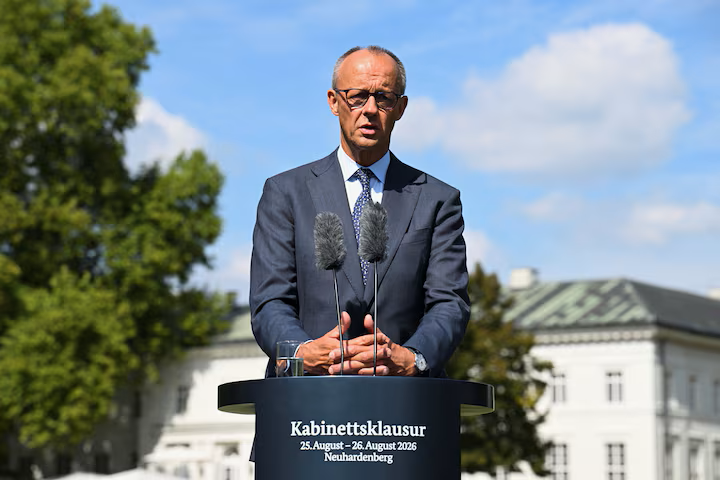
Chancellor Friedrich Merz on Wednesday vowed to revive the German economy and deliver growth of at least 1% next year thanks to business-friendly reforms and a planned increase in government spending.
Seeking to project unity, Merz and Finance Minister Lars Klingbeil, whose centre-left SPD is the junior partner in the coalition, also dismissed suggestions that government infighting was hampering efforts to reverse a slide in opinion polls.
"I feel encouraged in my assessment that we have the opportunity to achieve a one before the comma (in GDP growth) for the next year," said Merz, leader of the conservative CDU.
He was speaking at a news conference after an off-site cabinet meeting at the Neuhardenberg estate, about 70 km (44 miles) east of Berlin, following the summer break.
The economy ministry in April cut its 2026 growth forecast to 0.5% from 1%, citing higher energy costs linked to the war in Iran.
Pressure on Merz's coalition has been mounting after a cabinet reshuffle angered members of his own party and raised questions about the government's effectiveness as it seeks to fend off a far-right challenge in state elections next month.
IMPROVING ECONOMIC OUTLOOK
Merz and Klingbeil said recent economic data and business surveys pointed to an improving outlook.
After years of weak growth, Europe's largest economy expanded more strongly in the second quarter than initially estimated, while business morale rose to its highest level in a year in August.
Klingbeil said about €50 billion from a special 12-year €500 billion infrastructure fund — agreed in early 2025 — had been allocated.
"That is currently the strongest trend driving growth. We'd be in a recession without this investment push," the finance minister said.
But the debt-fuelled spending drive comes as German 10- and 30-year borrowing costs hit 15-year highs last week, with bond yields of major Western economies including the U.S. and Japan also on the rise.
Klingbeil, who on Monday attributed the higher borrowing costs to more expensive energy in the wake of the U.S.-Israeli war on Iran, stressed that Berlin's creditworthiness and ability to refinance were fully intact.
Merz also said he had asked federal ministers to develop proposals to address trade imbalances between the European Union and China.